
Frankly: We believed the footballer
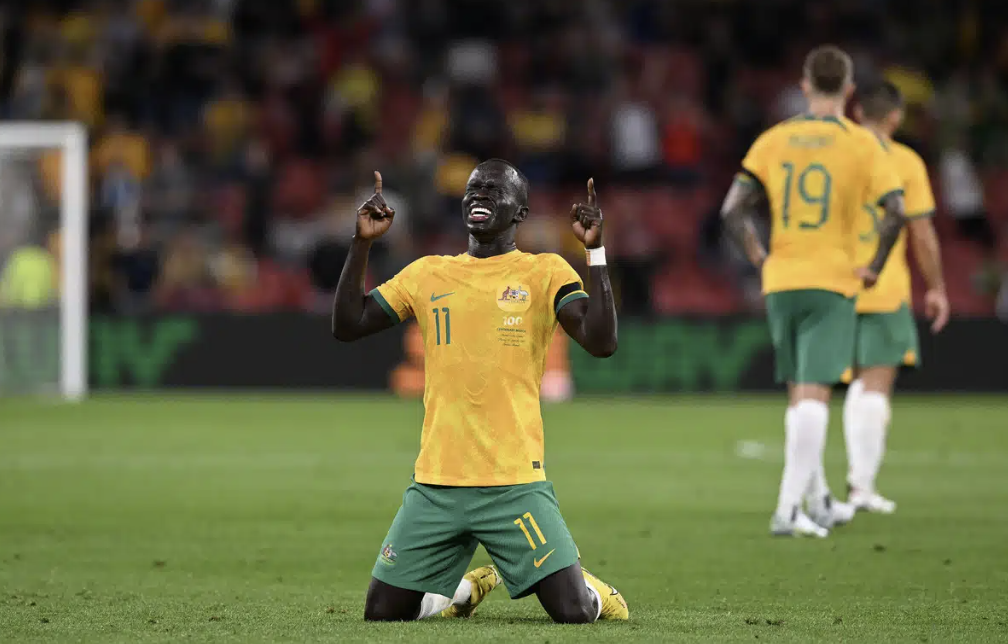
Credit: Africa Soccer.com
One of the smartest contributions to the latest monoculture controversy didn't come from a politician. It came from a footballer.
After Pauline Hanson's comments reignited the conversation, Socceroo Awer Mabil cut through the noise with four words.
"It's just all bullshit."
The colour of his language is irrelevant. What matters is that people listened. And not because he was a Socceroo but because he'd earned the right to speak.
Unlike many of the voices dominating this conversation in the media, Mabil wasn't theorising about multicultural Australia. He was describing the country he'd lived. A refugee from South Sudan who arrived here as a child. A kid who grew up in regional Australia. A man who now wears the green and gold alongside teammates whose stories reflect modern Australia far more accurately than a political slogan ever could.
His comments weren't powerful because they were polished. They were powerful because they came from experience. And that's part of a much bigger shift that's been happening.
For generations, we tended to accept authority at face value: politicians explained politics; CEOs explained business; journalists explained events; professors explained research. The title itself carried weight… But today, not so much.
Social media started the dismantling of gatekeepers, and with that, institutions stumbled, trust in politics, media and business eroded. Now AI has made it possible for almost anyone to produce polished, persuasive content in seconds.
The result? We've become far more sceptical of authority.
We've stopped asking, "Who has the biggest title?" And instead, we're asking, "Why should I trust you?"
It's one of the biggest shifts in communications in our lifetime.
And it's why people with lived experience have become some of our most influential voices.
We've even invented a profession around it. Influencers aren't influential because they hold institutional power. They're influential because they've built an audience. Millions of people choose to listen to them every day without a title, an office or a media organisation behind them.
That's a profound cultural shift.
To be clear, this is not about authority disappearing, it is about it being redistributed.
The expertise of great leaders, academics, journalists and CEOs is still important. And in many cases, they are still exactly the right people to lead the conversation.
But expertise has never belonged exclusively to people with titles. And we've become better at recognising it in people with proximity to the issue.
The nurse explaining what's happening inside the health system. The farmer talking about climate. The renter describing the housing crisis. The parent navigating disability. The refugee talking about belonging.
These are expert voices who have actually lived the issue, not just studied it.
For those of us working in communications, it’s an important distinction. We’ve instinctively reached for the person at the top of the organisational chart when seeking to add credibility, yet increasingly, credibility lives elsewhere.
Sometimes it is the CEO. But sometimes it's the apprentice. Or the customer. Or it’s the employee who's never spoken publicly before.
Our job isn't to manufacture trust through clever messaging. It's to recognise where trust already exists and give it the microphone. Because audiences are not looking for another polished statement. They want to hear from someone who's earned the right to be believed.
That's why Awer Mabil's comments resonate.
Not because he was the loudest voice in the debate. But because, in a conversation about what Australia is, people instinctively trust someone who helps shape it every time he leaves the house or pulls on the green and gold.
The organisations that understand this will tell better. more believable stories.
Bel